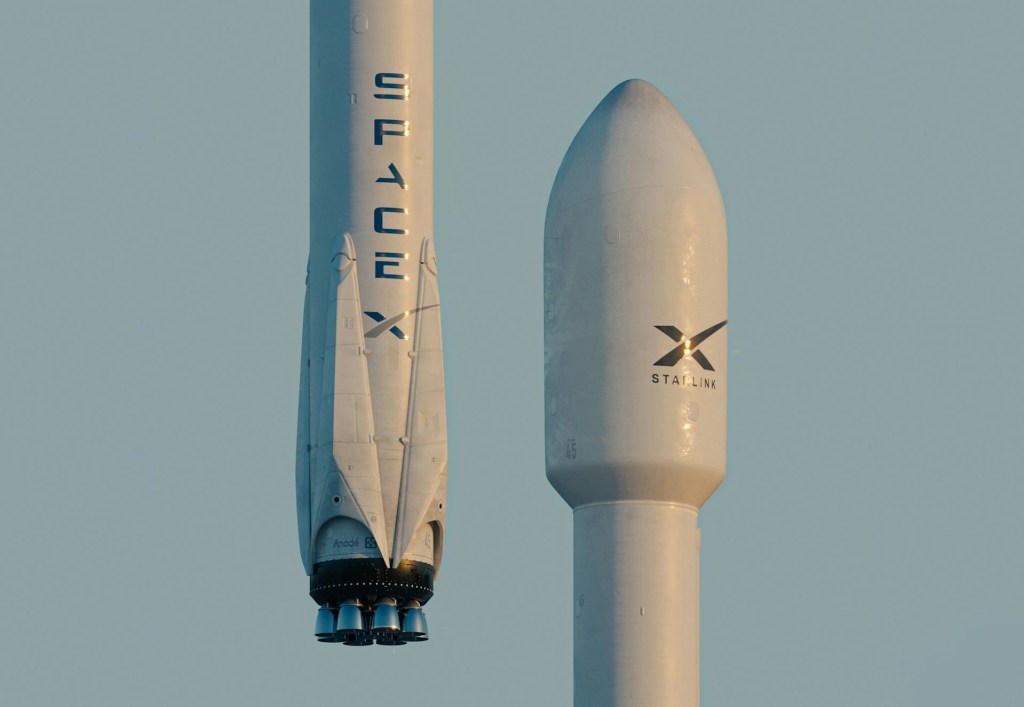
SpaceX finally put real third-generation Starlink hardware on a Starship rocket last Friday, and for about eight minutes, everything went right. Then the Super Heavy booster tried to relight its engines over the Gulf of Mexico, and things fell apart again.
This was Starship’s 13th test flight, launched from Starbase in Boca Chica, Texas, and it carried 20 Starlink V3 satellites, the first time this next-generation hardware had flown on the massive rocket. The satellites deployed on schedule, extended their solar arrays and antennas, and briefly linked into the broader Starlink network using laser links before burning up on reentry about 20 minutes later, exactly as planned. It was a suborbital test, not a permanent deployment, but it proved the mechanism worked.
I’ve been following Starship for years now, and honestly, the pattern here feels familiar. The upper stage keeps getting better while the booster keeps stumbling. This time, the Super Heavy booster separated cleanly and began its descent toward a simulated landing burn in the Gulf of Mexico.
But only a handful of the engines needed for that burn actually lit. The booster hit the water harder and faster than planned and exploded shortly after. It’s the second consecutive V3 flight where the booster has failed to stick its landing. In May, on the first Starship V3 flight, the booster failed as it separated from the upper stage entirely. This time it got further into the sequence before things went sideways.
A rough two weeks before the good news
What most articles missed is how close this flight came to not happening at all. SpaceX originally tried to launch Flight 13 on July 16, and that attempt ended before the rocket even left the pad. Four of the Super Heavy booster’s 33 Raptor engines failed to reach the parameters needed to ignite, and the flight computer triggered an automatic abort at T-0.
SpaceX swapped out the engines, then had to stand down again when Tropical Storm Bertha moved through the area. So by the time Friday’s launch actually happened, the team had already absorbed one scrubbed attempt and a weather delay on top of it.
Once it did fly, the upper stage of Starship put in one of its best performances yet. After deploying the satellites, it survived atmospheric reentry and executed a soft splashdown in the Indian Ocean, roughly 10,000 miles from the launch site. What really stood out to me is that the vehicle stayed mostly intact and floated upright in the water instead of breaking apart on impact. That let SpaceX send drones out to inspect the heat shield tiles up close, which is exactly the kind of real-world data engineers need to refine the design for future flights.
The IPO makes this a different kind of test
Here’s what’s interesting about the timing. This was the first Starship flight since SpaceX went public on the New York Stock Exchange under the ticker SPCX. The company priced its IPO at $135 a share on June 11, and the stock briefly ran as high as $225.64 before sentiment cooled. By the time Flight 13 lifted off, shares had already slid roughly 43% from that June peak, closing around $115.07 the day of the launch, just above the stock’s all-time low.
I didn’t expect this angle when I started digging into the aftermath, and that’s exactly why it matters: the stock barely moved after the launch. Even though the flight hit its major technical goals, satellite deployment, a working laser link, and a successful reentry, investors stayed cautious. Short interest in SPCX has climbed above 30% of available shares, up from single digits just a month earlier, which tells you a fair amount about how skeptical the market has gotten about Starship’s timeline.
Two dates are now looming large for anyone watching the stock. SpaceX reports its first quarterly earnings as a public company on August 4, and two trading days later, a large chunk of the IPO lockup expires, freeing up roughly 911.5 million shares. That’s a lot of potential selling pressure landing right on top of a rocket program that still hasn’t completed a full orbital flight in 13 attempts.
What comes next for Starlink V3
Industry insiders hint that SpaceX will keep flying Starship at a faster cadence now that the FAA has cleared the vehicle following its May mishap investigation, and the company hasn’t announced a firm date for Flight 14 yet.
Sources suggest the next flight will focus heavily on nailing that booster landing burn, since two failures in a row on the same vehicle configuration is the kind of pattern engineers can’t ignore. If the current trajectory holds, it looks like the next real milestone won’t be another suborbital demo; it’ll be an actual orbital Starlink V3 deployment, which is the whole point of building this rocket in the first place.
Starlink V3 satellites are a big deal beyond just this one test. They’re designed to carry far more bandwidth than the current V2 Mini satellites that make up most of the constellation, and SpaceX has said the network needs Starship’s massive payload capacity to deploy them at scale. Falcon 9 simply isn’t big enough to lift V3 satellites in meaningful numbers, which is part of why the constellation has kept expanding with older hardware while V3 waited for its ride.
In my opinion, this launch is a genuinely mixed result dressed up as a clean win in some of the initial headlines. The satellite deployment and the upper stage’s reentry performance were real progress, and I don’t want to undersell that. But a second straight booster failure on the V3 configuration, happening in full view of public shareholders for the first time, is not a small footnote. SpaceX has built its entire business on reusability, and until the Super Heavy booster can stick landings consistently on this new version of the rocket, every Starlink V3 flight is going to carry this same asterisk next to it.


