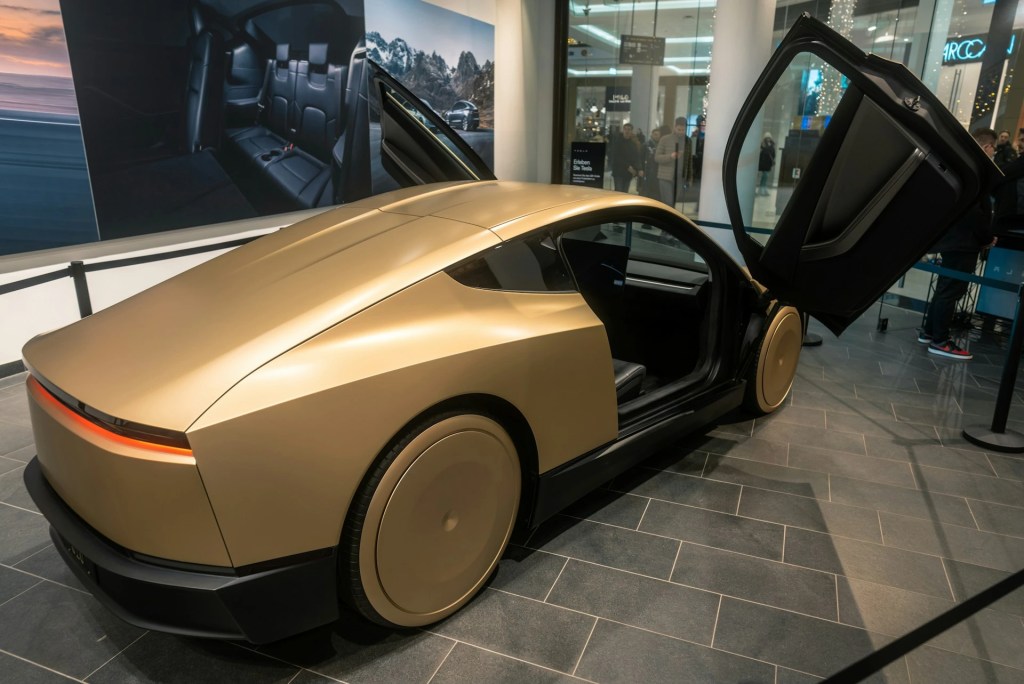
A new set of photos out of Austin just gave the clearest look yet at how Tesla is actually driving its steering wheel-free Cybercab on public roads, and the answer is blunt: it isn’t steering wheel-free at all, not yet. The Cybercab test mule in these images has a Cybertruck steering wheel bolted straight onto an exposed column, sitting behind pulled interior panels and mounted to what looks like a fabricated, adjustable rig. It’s the kind of unglamorous engineering detail Tesla doesn’t put on a keynote slide, but it tells you more about where the robotaxi program actually stands than any staged event could.
What the photos actually show
The wheel itself is the squared-off unit lifted straight from the Cybertruck, flat-bottomed and flat-topped, with no attempt to disguise where it came from. Behind it, the interior trim has been stripped away, so you can trace the steering column all the way down to a fabricated mount with what appears to be an adjustable rail, the kind of temporary rig engineers use when they’re still iterating on packaging. The car wore a Texas manufacturer plate, and it wasn’t hiding on a test track either. It was out on public streets doing exactly the job a validation vehicle is supposed to do.
Photographer Adam Machacek, who shared the images with Electrek, said this was his first time seeing the car up close and that he was struck by how compact and city-friendly its proportions actually felt. That reaction tracks with something else in the research: the Cybercab rides on the same next-generation platform. Tesla once discussed its long-promised $25,000 car before that project quietly morphed into a two-seat robotaxi. I’ve been following the Cybercab program for a while now, and honestly, this is the most honest look at its underside we’ve gotten yet.
Why a car with no steering wheel needs one
Tesla’s public position hasn’t changed. The production Cybercab is supposed to ship with no steering wheel, no pedals, and no mirrors at all. To move a finished unit around a depot without any of that, Tesla built a virtual joystick into the center touchscreen that lets a person drag the car around with a finger. That works fine for a controlled lot. A test mule collecting real driving data on public roads is a completely different job.
Here’s what’s interesting: most U.S. jurisdictions still require a licensed human able to take over during autonomous testing on public roads, and Tesla hasn’t gotten anywhere close to removing that requirement at scale. According to Tesla VP of Vehicle Engineering Lars Moravy, these wheel-equipped units belong to what he’s described as a remote-controlled fleet, built specifically for engineering validation and to satisfy state and federal testing rules. So instead of designing a bespoke set of interim controls, Tesla just grafted in a part that was already sitting on the shelf. The steering architecture lines up closely enough with the Cybertruck’s that it apparently just bolts on.
The bigger contradiction behind the program
This is where the story gets genuinely interesting, at least to me. Tesla began charging fares for Cybercab rides in Austin on September 3, 2026, rolling out roughly 1,000 of the two-seaters alongside its existing Model Y robotaxi fleet. NHTSA responded the same day, opening Audit Query AQ26002 to examine how Tesla self-certified a vehicle with no steering wheel, pedals, or mirrors under federal motor vehicle safety standards that were never written with a car like this in mind. The audit isn’t about how well the Cybercab drives itself. It’s about whether Tesla followed the right process when it declared the car road legal in the first place.
Amazon-backed Zoox took a slower, more cautious route to the same problem. It self-certified its own steering wheel free shuttle, then went and secured a temporary federal exemption that caps it at 2,500 exempt vehicles a year through July 2028. Tesla skipped that step entirely and self-certified straight into commercial service.
In my opinion, that’s about as on-brand a move as Tesla could make: certify first, start collecting fares, and let the fleet full of Cybertruck steering wheels keep doing the actual driving until a regulator says otherwise. Industry insiders hint that Tesla wants to expand Cybercab service to more vehicles and more cities as soon as the audit clears, though if the current trajectory holds, that timeline probably slips depending on what NHTSA finds buried in the certification paperwork.
What happens next?
None of this happens in a vacuum. Tesla’s Model Y robotaxi fleet has already disclosed 14 crashes to federal regulators since the Austin service launched, most resulting in property damage only, with two earlier incidents causing minor injuries. That history is part of why the audit matters. NHTSA is separately investigating Full Self Driving software across roughly 3.2 million Tesla vehicles, and a steering-wheel-free car entering commercial service into that environment was never going to slide through quietly.
What most articles missed here is a genuinely small but telling number: about 1,000 Cybercabs are covered under the current audit, a figure that got buried under bigger crash headlines even though it’s the actual scope of what regulators are reviewing right now. If Tesla clears that audit without being forced into a redesign, expect these Cybertruck wheel test mules to keep quietly doing the unglamorous validation work while the fully driverless version keeps getting all the public attention. The more I looked into this, the more it became clear the real story wasn’t the missing steering wheel Tesla keeps promising. It was the very ordinary one still bolted in behind the dash.
For now, the Cybercab is effectively two different vehicles wearing the same body. One is the driverless product Tesla keeps marketing, controlled by nothing but cameras and software. The other is a test mule with a Cybertruck wheel bolted to a temporary rig, doing the unglamorous job of proving the first one actually works before regulators sign off. Until NHTSA finishes picking through Tesla’s certification file, that contradiction is exactly what the Cybercab program looks like up close.


