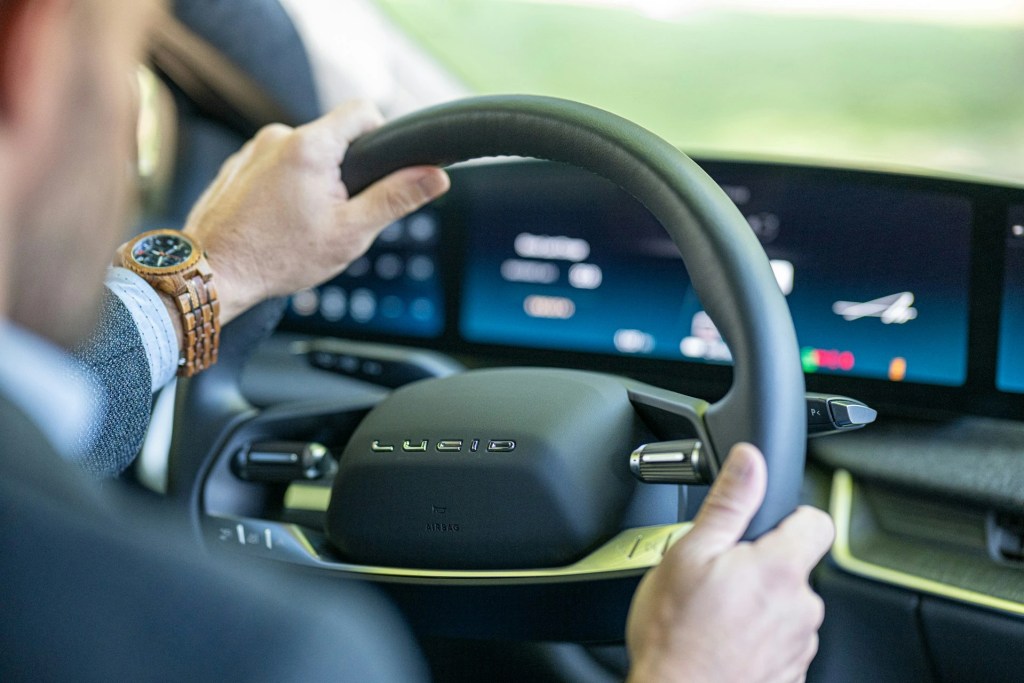
Lucid just made another gigantic robotaxi promise, and this one lands barely six weeks after the company delayed the very vehicle it’s supposed to be built on. Lucid and Bolt announced a partnership this week that will see the European ride-hailing giant put at least 25,000 autonomous Lucid EVs onto its network. It’s a massive number on paper. It’s also the second enormous autonomous-fleet deal Lucid has signed in just over a year, and I think that timing tells you almost everything you need to know about where this company’s head is at right now.
Here’s the setup. Bolt is Europe’s largest shared-mobility platform, and it’s not a small player by any measure. We’re talking more than 200 million customers, 4.5 million drivers and couriers, and operations spread across over 50 countries and 850 cities. The company has said this Lucid Bolt agreement is “a major step” toward a much bigger target: 100,000 autonomous vehicles running on its platform by 2035. Bolt will own and operate the fleet itself, and its dedicated Bolt Autonomous Driving Solutions unit will lead the work going forward.
What the Lucid Bolt deal actually covers
The vehicles at the center of this agreement will be built on Lucid’s upcoming Midsize platform, the smaller and cheaper architecture the company has been counting on to finally drive real sales volume. They’re being designed from the ground up for SAE Level 4 autonomy, and the two companies plan to co-develop what they’re calling an “ADS-ready” vehicle rather than retrofitting an existing consumer car later. That’s a genuinely smart approach on paper. Building autonomy in from the product stage tends to work out better than bolting sensors onto a car that was never meant to carry them.
The companies expect to use NVIDIA Hyperion, which is a production-ready reference architecture that bundles high-performance compute with a standardized sensor suite. Bolt will handle the vehicle, software, safety, and rider-experience requirements, plus build out the operating infrastructure needed to actually run the cars. Bolt founder and CEO Markus Villig put it plainly, saying autonomous driving in Europe requires data, software, vehicles, and operations to function as one system built specifically for European roads and regulation.
What nobody has nailed down yet is a launch date. Neither company has said when the first of these 25,000 vehicles will actually hit European streets, and that’s worth sitting with for a second given how far out some of these platform timelines already run.
Why I’m skeptical of the numbers
I’ve been following Lucid’s autonomy push for a while now, and honestly, the pattern here is hard to ignore. First it was 20,000 vehicles with Uber. That deal has since grown to at least 35,000 vehicles across the Gravity and Midsize platforms, backed by $750 million in fresh capital, including $550 million from an affiliate of Saudi Arabia’s Public Investment Fund and $200 million from an Uber subsidiary. Now it’s 25,000 more with Bolt. On paper, that’s 60,000 committed autonomous vehicles across two continents from a company that made fewer than 4,000 cars last quarter.
And in every one of these deals, Lucid is playing the same role. It’s the hardware vendor. The actual autonomy software comes from somewhere else, whether that’s Nuro on the Uber side or an as-yet-undisclosed partner on the Bolt side. What most articles missed in the excitement over the headline number is that the announcement never actually names who will deliver the Level 4 driving capability for the European fleet. Hyperion gives you the compute and the sensors. It doesn’t drive the car by itself.
This all comes against a backdrop that’s genuinely rough for Lucid right now. New CEO Silvio Napoli laid off around 18% of the U.S. workforce this year, on top of an earlier 12% cut, eliminated the second production shift at the Arizona plant, and pulled the company’s full-year production guidance entirely. Napoli was remarkably candid about it too, telling investors the company had “disappointed on several fronts, and for far too long” and admitted Lucid had launched products before they were ready. Then, just six weeks before the Bolt announcement, Lucid pushed the Midsize platform’s launch back to the second half of 2027. That’s the exact platform these 25,000 Bolt vehicles are supposed to run on.
Two continents, two very different bets
The Uber program and the Bolt program aren’t the same play. Uber’s deal centers on the existing Lucid Gravity SUV paired with Nuro’s driving technology, and it’s already producing real test vehicles on real roads in the San Francisco Bay Area and Houston. The Bolt agreement is built entirely around a vehicle platform that doesn’t exist commercially yet. That’s a meaningfully bigger bet, and it’s one Lucid is making at a moment when its own management has admitted the company can’t be trusted to hit its stated timelines.
Sources close to the European autonomy space suggest Bolt isn’t putting all its chips on Lucid anyway. The company already has a partnership with Stellantis targeting Level 4 vehicles across Europe, a three-way “Living Lab” testing program with Pony.ai and Stellantis running in Luxembourg, and a separate Nvidia Drive Hyperion partnership announced earlier this year. If the current trajectory holds, Bolt looks like it’s building a portfolio of autonomy bets rather than depending on any single automaker to deliver.
What this means for the next few years
I actually think the ambition here is the right one, even if the timeline feels shaky. Europe has genuinely lagged the U.S. and China on autonomous mobility, and Villig has said as much publicly, warning that roughly 10% of the EU’s economy is tied to car manufacturing and that missing this wave would be a serious setback for the region. A Lucid Bolt partnership that actually delivers would be a real step toward closing that gap.
But 25,000 vehicles built on a platform that just slipped a year, from a company mid-restructuring, with no named autonomy software partner and no announced launch date, is still mostly a promise right now rather than a plan you can put a date on.
Deploying at Bolt’s stated scale will demand more than manufacturing capacity. European regulators across dozens of countries will need to sign off, real-world testing will have to prove the tech works on unfamiliar road layouts, and Lucid will need to actually ship the midsize platform it just delayed. The Lucid Bolt announcement is a significant demand signal for a company that badly needs one. Whether it becomes 25,000 cars on the road or another headline number that quietly slides is the part worth watching over the next couple of years.


