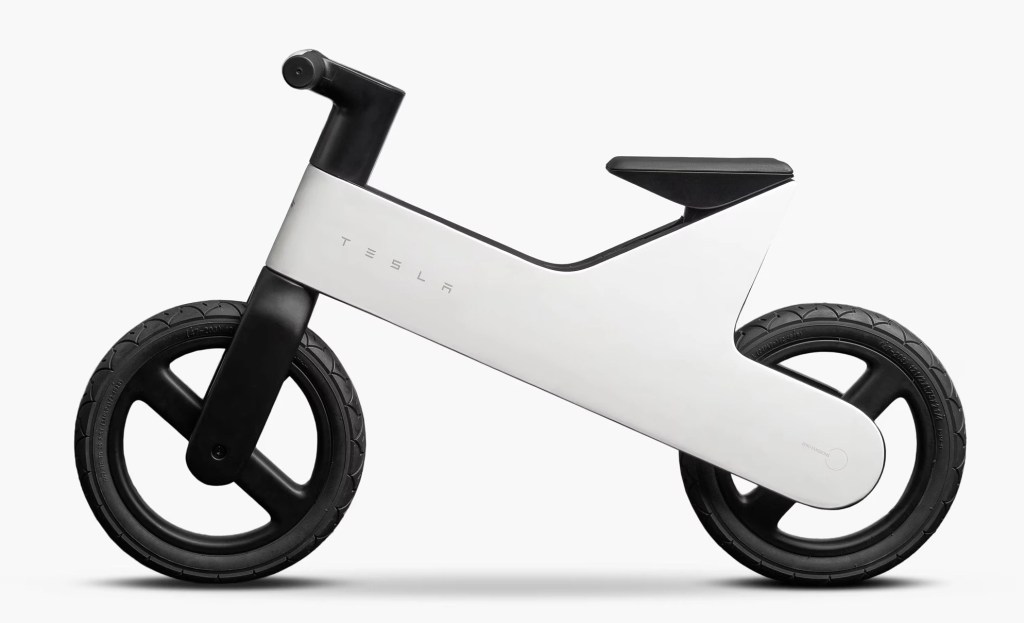
Tesla just launched its first bike, and it’s not the electric two-wheeler fans have been begging for since forever. It’s a toddler balance bike, and it costs $225.
The new “Balance Bike for Kids” sells for $225 on Tesla’s online shop and is aimed at children aged 2 to 5, arriving at a moment when a survey or a fan rendering periodically reignites the idea of a Tesla two-wheeler. In my opinion, that timing is not an accident. Buyers have repeatedly named Tesla as the electric bike brand they most want to see, and rumors of a “Tesla Model B” e-bike have circulated for nearly as long as the company has made cars. I’ve been following this for a while, and honestly, every time the rumor resurfaces, it fizzles out just as fast.
What You Actually Get for $225
So here’s what showed up instead. The balance bike features a lightweight magnesium frame, an adjustable seat with five height levels, and the Tesla wordmark on the side with the “T” logo on the front. There’s no drivetrain; kids push along with their feet, which is the entire point of a balance bike.
The spec sheet backs that up. Tesla says the bike is designed for children aged 2 to 5 years old and has five predetermined seat heights that let the bike grow with your child. It’s built for smaller riders too. The bike comes with a lightweight white magnesium frame, a five-way adjustable seat in black, tools for assembly, the Tesla wordmark on the side, and the T logo up front, and it’s rated for kids under 77 pounds with legs less than 13 inches long.
What I find interesting here is that Tesla didn’t even try to dress this up as a mobility product. There’s no battery, no motor, no app. It’s a piece of shaped metal with two wheels and a seat, and the brand name is doing most of the heavy lifting on the price tag.
Why the Price Is Raising Eyebrows
This is the part that’s generating the most chatter, and rightly so. At $225, Tesla is charging a premium, though not a completely absurd one compared to the high end of the category, since a perfectly good balance bike runs $50 to $120 from most brands, and the magnesium-framed Hornit AIRO sells for around $73. But once you stack it against the actual premium tier, the picture shifts. Tesla’s price only starts to look reasonable next to the specialty premium models: the magnesium-frame Woom 1 goes for $249, and the Strider 14x Sport lists at $220.
Put plainly, Tesla priced its logo’d toddler bike right alongside the most expensive balance bikes on the market, above what most parents should ever spend on one. I actually think that’s the whole strategy. Tesla isn’t competing with the $60 Target aisle bike. It’s competing with boutique brands that already charge premium money for magnesium frames and are slapping a recognizable badge on top of that same price bracket.
Industry watchers see it similarly. The premium balance bike market, with brands like Strider, WOOM, and Prevelo, typically ranges from $100 to $350 depending on frame material and build quality, and a magnesium-frame balance bike at $225 sits in the mid- to upper tier of that range, broadly consistent with what magnesium construction commands over standard aluminum models.
It sold out almost immediately.
Here’s the part that surprised me the most. The premium two-wheeler dropped on Tesla’s digital storefront for $225, and according to the official Tesla Shop product listing, the initial batch of orders will begin shipping out in late August, but eager parents looking to secure one right away were quickly out of luck. Sources at the shop confirm demand outpaced supply within hours. The sleek trainer sold out almost immediately after going live, though shoppers can still sign up on the Tesla Shop to get an automated email notification as soon as a restock happens.
That’s a fast sellout for a toddler accessory, and it says something about how deep the appetite for Tesla-branded merchandise runs among owners. As of Friday, July 17, 2026, the bike is listed as out of stock on the Tesla Shop, with customers able to sign up for email notifications when it becomes available again, and shipping for initial orders is expected to begin in late August. This is one of those things I genuinely got excited about the moment I saw it sell out, just because it confirms Tesla merch has a fanbase that moves fast regardless of what the product actually is.
Not Tesla’s First Rodeo With Kids’ Vehicles
This isn’t uncharted territory for Tesla’s lifestyle arm. In 2021, Tesla partnered with Radio Flyer to release the Cyberquad for Kids, an electric ATV inspired by the Cybertruck design. That product had a rockier road than this one. The $1,900 mini ATV was recalled due to safety concerns flagged by the Consumer Product Safety Commission, with Radio Flyer handling the recall after about 5,000 units had been sold.
The balance bike is a much simpler product by comparison: no battery, no throttle, and no suspension calibration to get wrong. What most articles missed is that this simplicity might be intentional risk management after the Cyberquad recall headache. If the current trajectory holds, it looks like Tesla is sticking to low-complexity, high-margin lifestyle goods rather than anything resembling an actual powered vehicle for kids going forward.
Eligibility Requirements Add a Twist
There’s a catch that a lot of coverage glossed over. According to the Tesla Shop listing, buyers need to be verified Tesla vehicle owners to purchase certain items in this lifestyle category, and some VINs are excluded if they already redeemed related perks like Cyber Wheel Cap Kits. That’s a small but telling detail. This isn’t really a toy for the general public; it’s a loyalty perk dressed up as a toy, aimed squarely at existing owners rather than casual shoppers browsing for birthday gifts.
What This Means for Tesla’s Merch Strategy
Industry insiders hint that this launch is less about bikes and more about testing how far the brand halo stretches into everyday parenting purchases. Tesla has steadily expanded its shop beyond vehicle-specific accessories into apparel, toys, and branded goods, and the balance bike continues that trend, targeting Tesla owners who are also parents of young children. Honestly, this is the part of the story that most people are sleeping on. It’s not about whether the bike is good value; it’s about Tesla learning it can sell almost anything with the wordmark stamped on it, at almost any price, to its own owner base.
Whether the electric Tesla bike ever shows up is still an open question. But for now, if you’re a Tesla owner with a toddler and you’re fast enough on the restock notification, you’ll be paying premium prices for a product that, mechanically speaking, is just metal, two wheels, and a seat your kid pushes with their own feet.


