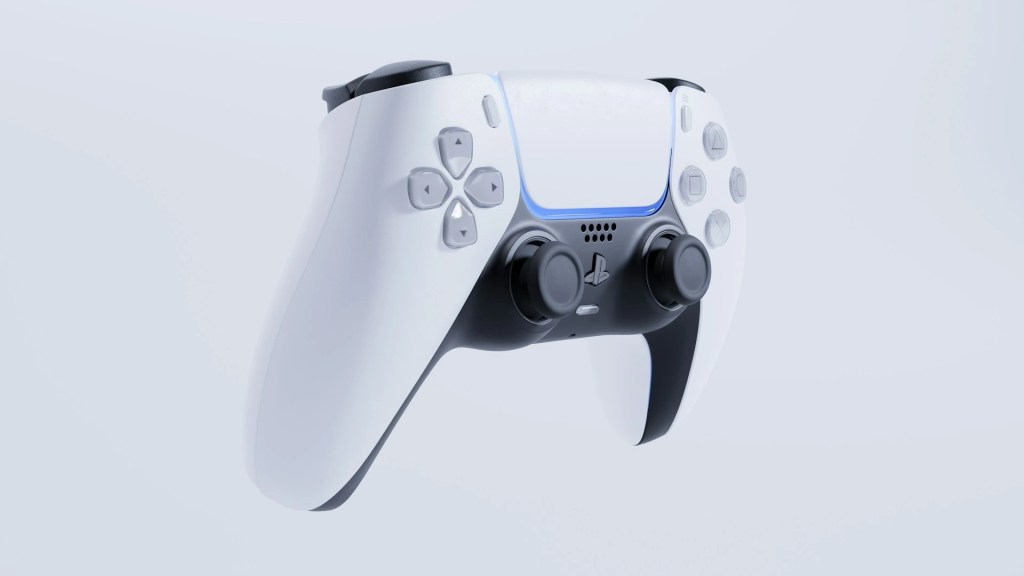
If you thought the DualSense was the final word on PlayStation controllers, Sony just filed two patents that suggest otherwise, and they don’t even agree with each other.
The first PlayStation controller patent, granted by the US Patent and Trademark Office on January 27, 2026, describes something that barely looks like a gamepad anymore. A Sony-filed patent revealed designs for a “buttonless” controller that would use touchscreens instead of the traditional buttons, d-pad, and thumbsticks, with elements that could be resized and moved around at will. I’ve been following Sony’s patent filings for a while, and honestly, this one stopped me mid-scroll.
Imagery in the patent depicts a controller with two large touchscreens situated where the d-pad, face buttons, and thumbsticks would normally sit, positioned on the left and right of the pad with a central push button dividing the two. So instead of a fixed cross button living in one spot forever, you’d get a screen that draws its own buttons wherever your fingers land.
Why Sony wants to kill the physical button
The reasoning isn’t just “because we can.” The patent’s background section points to a real complaint: a fixed layout may be too small or too large for a user, and it may simply not be comfortable for everyone. That’s a genuine accessibility problem, and Sony already has skin in that game.
Sony currently addresses different accessibility needs with dedicated hardware, like the PlayStation 5 Access Controller, which launched in December 2023, so a single adaptive device would be a logical next step rather than a random experiment. What I find interesting here is that Sony isn’t pretending this replaces everything overnight. It reads like a long game.
The controller would support gestures such as taps and swipes while dynamically adapting control zones to finger positions, and according to one report I dug into, optical sensors embedded beneath the surface could register contact, heat, pressure, and even a “pretouch” movement approaching the controller before a finger actually makes contact. That pretouch detail barely got mentioned anywhere, and it might be the most underreported piece of the whole filing.
Sources suggest this buttonless concept has been quietly building since 2023. The application was actually filed back in February 2023 and only issued in late January 2026, under the title “designs and methods for a game controller.” Patents can sit in the pipeline for years before anyone outside a law firm ever sees them, and that gap alone tells you Sony has been chewing on this idea for a while.
Then Sony filed a second, completely different controller
Here’s the part that most articles missed. Less than six months after the buttonless patent surfaced, Sony published a second controller patent that goes in almost the opposite direction. Instead of erasing physical parts, it rearranges them.
Sony’s latest PlayStation controller patent, published on July 16, 2026, sketches a modular design built around swappable parts rather than a fixed DualSense layout. At the center of the concept is a detachable touchscreen that replaces the DualSense touchpad, and according to the filing, the screen could show menus, settings, notifications, messages, and phone calls, working like a smartphone screen or a physically clickable surface.
There’s also a small mechanical detail that I genuinely got excited about the moment I read it. The controller includes a rotating navigation dial that can be used to scroll through menus and settings, with pressing it confirming a selection without forcing the player to look away from the game. That’s the kind of small, practical touch that suggests real engineering thought, not just a patent lawyer covering bases.
The patent covers a modular controller built on a four by seven magnetic grid, where thumbsticks, directional controls, and the touchscreen module can each be detached and repositioned on that grid. When I first heard about a “grid” controller I pictured something clunky, but the actual filing sounds closer to building blocks than a spreadsheet.
The concept appears in US patent application US 2026/0199776 A1, published on July 16, 2026, and the document does not link the technology to PlayStation 6, having been filed back on January 16, 2025, by inventor Daniel Morales. That filing date matters. It means Sony was sketching a modular grid controller a full year before the buttonless patent even became public, which flips the usual assumption that these ideas showed up back to back on purpose.
Two visions, one obvious tension
It’s rumored that both of these could eventually feed into whatever comes after the DualSense, but they can’t both be the plan. One removes physical feedback entirely and bets on adaptive software. The other keeps physical parts but lets you rebuild the whole layout by hand. Industry insiders hint that Sony is more likely testing reactions to two extremes before landing somewhere in the middle.
For context on just how many ideas Sony floats without shipping them, a snapshot of the USPTO database reviewed by GameRant shows Sony Group and its subsidiaries hold 133,506 US patents as of January 31, 2026, making Sony the 14th most prolific patent filer of the year, immediately below Dell and above Intel. The vast majority of those never touch a store shelf. That context alone should temper expectations here.
Still, I don’t think either patent is just noise. Sony has a habit of quietly testing ideas years before they ship, and the DualShock, Sixaxis, and DualSense controllers all started somewhere similarly speculative. Personally, I think the modular grid patent is the more realistic near term candidate, since it keeps the muscle memory players rely on while still allowing customization.
The buttonless design is the bigger swing, and probably the riskier one. The obvious problem is muscle memory, since nobody wants to hunt for a glass cross button mid-firefight, and that’s a real concern for anyone who plays competitive shooters or fighting games where split-second inputs matter.
What nobody talks about is the accessibility angle
Most coverage treats these patents as gadget curiosities, but the accessibility framing running through both filings is the part that actually matters long-term. A controller that reshapes itself around a player’s hands, or one where you physically relocate a stick because of limited mobility, solves problems that dedicated accessibility hardware has only partially addressed. If the current trajectory holds, it looks like whatever ships next will borrow pieces from both patents rather than picking one wholesale.
A second, unrelated patent uncovered in April 2026 even pushed the idea further with a deformable “pinch and twist” grid featuring a 5×5 array of 25 individual nodes covered in flexible material, which tells you Sony’s research teams are experimenting well beyond just these two filings.
None of this is confirmed for PlayStation 6 or any specific product, and Sony hasn’t said a word officially. But when a company known for testing hardware ideas years in advance suddenly files two structurally opposite controller patents in the same calendar year, it’s a strong signal that the PlayStation controller as we know it is due for its biggest rethink since the original DualShock.


