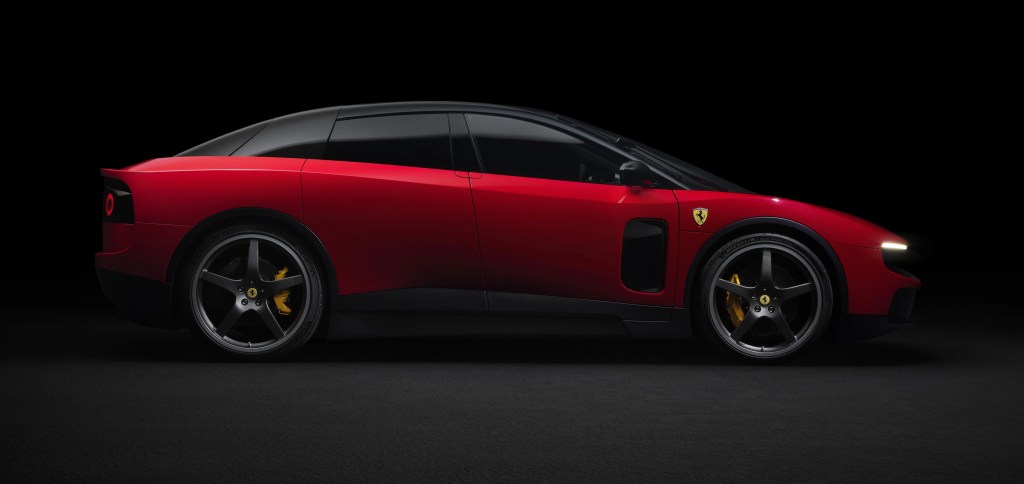
There’s a certain kind of irony that lands differently when you see it play out in real life. Apple spent over a decade and billions of dollars trying to build an electric car through Project Titan, only to cancel the whole thing quietly in February 2024. And now, just two years later, the ghost of that dream has shown up wearing a Ferrari badge.
The Ferrari Luce, pronounced “Lu-chey” and meaning “light” in Italian, is Ferrari’s first-ever all-electric vehicle. Its interior, designed by none other than Jony Ive, the man behind the iPhone, the iPad, and virtually every iconic Apple product since the late 1990s, looks exactly like what the Apple Car might have been. That’s not a stretch or a loose metaphor. When you see the photos, the connection is almost uncomfortable in how obvious it is.
What the Ferrari Luce actually is
At its core, the Ferrari Luce is a four-door, four-seat electric sedan with specs that would embarrass most traditional supercars. It runs four electric motors producing 1,113 horsepower, goes from 0 to 60 miles per hour in just 2.5 seconds, carries a 122 kWh battery supplied by SK On, and delivers a 330-mile range on a full charge with support for up to 350 kW of DC fast charging.
The car weighs around 5,100 pounds, which is heavy for a supercar but remarkably manageable given what it’s packing underneath. Ferrari built an entirely new platform called the 880V architecture specifically for the Luce, and it’s being assembled in a dedicated facility in Maranello called the E-Building. The full exterior was revealed on May 25, 2026, in Rome, but the interior was previewed in San Francisco back in February, and that’s where the story gets genuinely fascinating.
The Ferrari Luce interior is basically an Apple product.
When Ferrari first pulled back the curtain on the Luce’s cabin in San Francisco, the Apple design influence was impossible to miss. The infotainment system features a 10-inch iPad-like floating screen. The instrument cluster is a 12.5-inch Samsung OLED panel with a physical needle that actually pokes through the display, thanks to Samsung’s proprietary Hole in Active Area technology.
There are Apple Watch-style digital crowns on the controls. Brushed aluminum and Gorilla Glass are everywhere, and the steering wheel is a clean three-spoke design. Every physical switch is shaped differently, so you can tell them apart purely by touch, without ever taking your eyes off the road.
I’ve been following Jony Ive’s work for years, and honestly, the moment I saw the Luce cabin photos, I had a very clear reaction: this is what the Apple Car would have looked like. Not literally, of course. But in terms of design DNA, the connection is unmistakable.
Ive himself confirmed that LoveFrom, his creative collective co-founded with designer Marc Newson, had been working with Ferrari for five full years on this project, a partnership that reportedly began shortly after Ive left Apple in 2019. Engadget, which got a walkthrough with Ive in person, quoted him as saying, “We use some touch in the central screen, but it’s very thoughtful, and the vast majority of the interfaces are physical.” Every single switch feels different, so you don’t need to look. “That’s not automotive engineering language. That’s a product philosophy.
What Apple’s Project Titan actually was
Apple kicked off Project Titan around 2014, and for the next decade, it ballooned into one of the most secretive, expensive, and turbulent internal projects in Silicon Valley history. At its peak, the team had around 2,000 employees working on it. The vision shifted multiple times, from a fully autonomous vehicle with no steering wheel or pedals to a more conventional electric car with partial highway self-driving capability. Apple reportedly spent billions and never got close to a finished product. In February 2024, COO Jeff Williams and VP Kevin Lynch quietly told the team it was over, and most employees were shifted to AI teams.
What most articles missed at the time is that I’ve reportedly expressed frustration with Project Titan’s direction as early as 2015, years before leaving Apple entirely in 2019. So in a very real sense, the person most capable of defining what an Apple Car would feel like had already walked away before the project died. Apple never showed the world a single official interior or exterior image from Titan. The design side was among the most closely guarded secrets in the company’s history.
Why the Luce feels like an answer to a question nobody got to ask
After looking into this more closely, I can tell you that the reaction to the Ferrari Luce has been genuinely split along a very clear line. The interior has received widespread praise from both tech and automotive media. Car and Driver called it spectacular. The philosophy behind it, minimal tactile controls, premium materials, and an interface that prioritizes intuition over complexity, is exactly what you’d imagine from a world where Apple had followed through on its EV ambitions and actually finished the job.
The exterior, however, is a completely different story. According to TechCrunch, the Luce is tracking to be “the most mocked new vehicle since the Cybertruck.” Armchair critics on Reddit have described its wedge-shaped silhouette as giving off “Waymo vibes,” with some lamenting that it looks “somehow worse than I could ever have imagined.” Others have compared it to a Nissan Leaf, which starts at $29,990, while the Luce costs €550,000, roughly $640,000. Ferrari’s stock dropped following the exterior reveal. Both Ive and Ferrari’s chief designer, Flavio Manzoni, have strongly defended their creative choices, pushing back against what they see as a demand for lazy, predictable aesthetics.
Personally, I think the exterior controversy actually strengthens the Apple Car argument, not weakens it. If Apple had launched a car that looked this quiet, this restrained, this deliberately unconventional, the backlash would have been identical. Apple has always made products that felt wrong at first glance and completely right once you actually used them. The original iPhone got mocked for having no keyboard. The first MacBook Air was called too thin to be useful. The Luce may be exactly that kind of product: something that takes time for the world to catch up to.
What comes next for the Ferrari Luce
Sources suggest Ferrari is already managing demand carefully, with its order book reportedly extending toward the end of 2027 for its broader lineup. Industry insiders hint that the Luce will likely be produced in limited annual numbers to preserve exclusivity, consistent with Ferrari’s long-standing philosophy of disciplined supply. Reports from Evercore ISI, which reaffirmed a Buy rating on Ferrari stock, suggest the company expects earnings to grow by 6 percent in 2026 as the Luce rollout takes shape across global markets.
What I find most interesting here is that the Ferrari Luce has done something the tech world hasn’t managed in years: it’s made people genuinely imagine what a premium electric vehicle experience could feel like when it’s built from first principles instead of borrowed from a Tesla playbook. It puts physical controls back at the center, treats materials with seriousness, and dares to make a car that feels closer to a MacBook than a giant touchscreen on wheels. Apple killed Project Titan before the world ever got to see it. But if the Ferrari Luce is any indication of what Jony Ive would have done with a car, it’s clear that the Apple Car would have been really, really nice.


