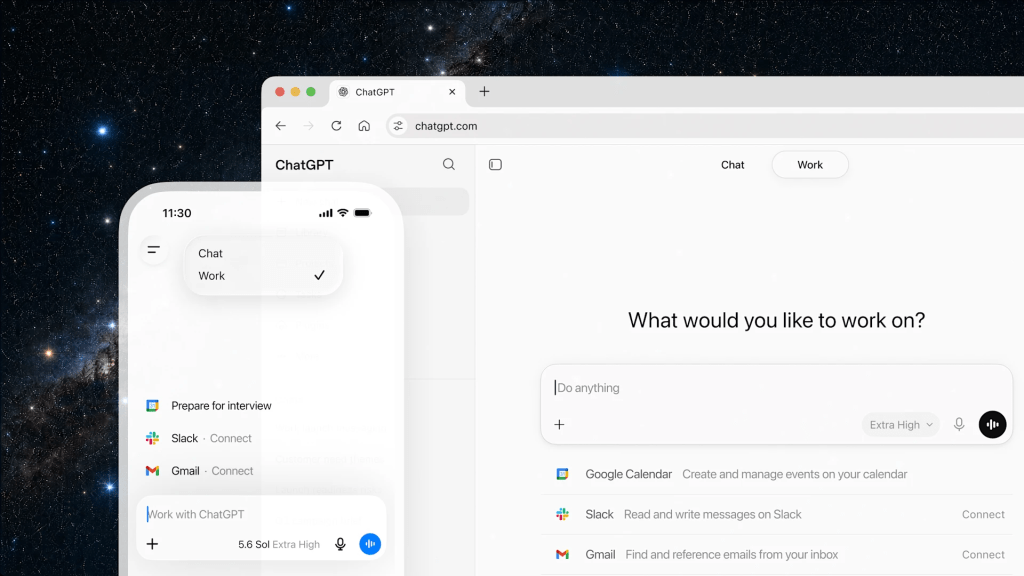
OpenAI didn’t just ship a new model this week. It shipped an entire rethink of what ChatGPT is supposed to do for the people who use it every day at work.
On July 9, the company introduced ChatGPT Work, a new agent built on its freshly released GPT-5.6 model family. And after digging through the announcement, the reviews, and the early reactions pouring in from Reddit, I think this is one of those releases that looks incremental on paper but feels different once you actually use it.
Here’s what’s interesting: this wasn’t a simple, same-day launch. GPT-5.6 spent close to two weeks in a restricted preview after the Trump administration asked OpenAI for more time to evaluate the model for national security risks, particularly around cybersecurity and biological research. Sam Altman told CNBC the process involved “many changes” following what he called a collaborative back and forth with the government. That’s not something you see mentioned in most of the launch day coverage, and it’s honestly one of the more underreported parts of this whole story.
What ChatGPT Work actually does
ChatGPT Work is an agent, not a chatbot. It’s built on Codex, and it’s designed to handle long-running, multi-step tasks instead of answering one prompt at a time. You describe a goal, something like preparing a quarterly report, researching competitors, or building a spreadsheet from scratch, and the system breaks that goal into smaller steps, pulls context from your connected apps and files, and works independently for hours if it needs to.
It runs across web, mobile, and desktop, and the desktop rollout is the interesting part. OpenAI merged Codex into the ChatGPT desktop app, so users on Mac and Windows now get Chat, Work, and Codex functionality inside one unified application. The company is calling the older interface “ChatGPT Classic” going forward, which tells you how seriously they’re treating this as a generational shift rather than a feature update.
Access is rolling out first to Pro, Enterprise, and Edu subscribers, with Plus and Business users getting it within days. I’ve been following OpenAI’s product decisions for a while, and honestly, the staggered rollout by tier feels deliberate. It lets the company work out infrastructure kinks before the flood of Plus tier traffic hits.
GPT-5.6 brings three distinct model tiers
GPT-5.6 doesn’t ship as one model. It comes in three flavors, and the naming convention itself is new. Sol is the flagship, built for the hardest reasoning and agentic coding tasks. Terra is the balanced, everyday work model, priced to compete directly with GPT-5.5 while costing half as much. Luna is the fast, budget option meant for high-volume use.
OpenAI explained that in this new system, the number identifies the model’s generation, while Sol, Terra, and Luna represent capability tiers that can now advance independently. That’s a meaningful structural change. Personally, I think this signals OpenAI moving away from the idea of one model to rule everything toward something closer to a product line, similar to how car manufacturers offer trims.
Pricing per million tokens breaks down as $5 input and $30 output for Sol, $2.50 and $15 for Terra, and $1 and $6 for Luna. Altman told CNBC that Sol is 54% more token efficient on agentic coding tasks compared to its predecessor, a stat that barely made headlines outside of Axios but matters enormously to enterprises watching their AI spend closely.
What most articles missed is that GPT-5.6 also introduces a new “ultra” mode, which coordinates multiple agents working in parallel to finish complex tasks faster. It’s available to Pro and Enterprise users inside ChatGPT Work and to Plus and higher plans inside Codex.
Reddit’s reaction was split, and that’s telling
I didn’t expect this angle when I started researching, and that’s exactly why it matters. The community response wasn’t the usual wave of unanimous hype. Over on r/codex, users described one-shot web builds that would have produced a spinning mess on GPT-5.5, and some vibecoding testers ranked Sol above Anthropic’s Opus 4.8 and close to its top-tier Fable model.
But the complaints weren’t really about intelligence. They were about plumbing. Plus subscribers reported Sol simply missing from their accounts entirely. Others bounced between the Codex app, the older Windows Store ChatGPT app rebranded as Classic, and a separate Codex Beta build before finding the right place to even access the new models. When a chunk of a launch day megathread is people helping each other figure out which icon to click, it tells you the software shipped a step ahead of the distribution plan.
A widely read post in r/claude offered a more measured take, arguing Sol is genuinely impressive in places but not a category killer compared to rival frontier models. That’s a fair assessment, and it lines up with what independent testers have said. MagicPath AI’s CEO Pietro Schirano called it the best model he’s used, calling it fast, smart, and genuinely creative. Meanwhile, Every’s CEO, Dan Shipper, compared GPT-5.6 to a Porsche while describing Anthropic’s competing model as offering warp drive by comparison. Different people are clearly optimizing for different things, and that nuance rarely survives the headline versions of this story.
Why the timing matters more than it looks
Sources suggest the delayed rollout wasn’t purely a technical decision. It followed a broader pattern of government engagement with frontier AI labs, and Anthropic has reportedly gone through similar reviews with its own releases. Industry insiders hint that this kind of preclearance process, informal as it currently is, could become a more standard part of how major model releases happen going forward.
If the current trajectory holds, it looks like the AI industry’s biggest players are heading toward a future where cybersecurity and biosecurity evaluations happen before public launch as a matter of course, not as an exception. That’s a meaningful shift from how things worked even a year ago, and I think it’s the part of this story that will matter most looking back on it in six months.
The launch also sharpens the competitive picture around workplace AI agents. ChatGPT Work arrives months after Anthropic’s own Claude Cowork, and the framing from both companies is nearly identical: less prompting, more autonomous execution, and agents that stay with a task instead of waiting for the next instruction. The battle for who owns the AI-powered workday is clearly just getting started, and GPT-5.6 is OpenAI’s clearest statement yet that it intends to compete hard for that space.
For anyone using ChatGPT regularly for actual work rather than casual questions, this release is worth paying close attention to. The rough edges around app confusion will likely smooth out within weeks. What won’t change is the direction OpenAI has committed to: an assistant that finishes work, not just one that talks about it.


