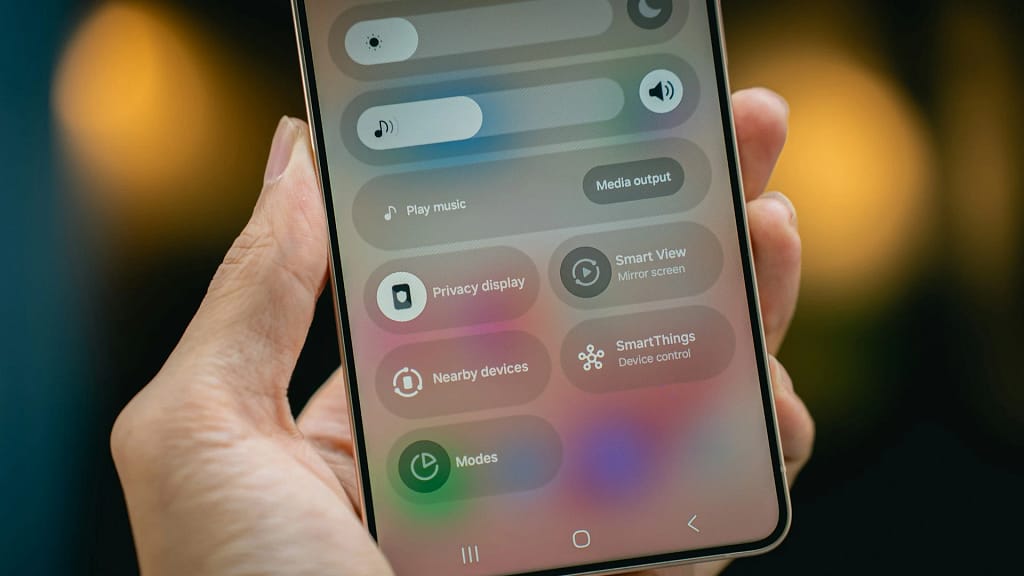
Samsung has launched a groundbreaking display technology with the Galaxy S26 Ultra that protects your screen from unauthorized viewers. Known as Privacy Display, this hardware-based feature applies pixel-level control to apps and notifications, ensuring sensitive information stays private in public settings. For end-users across the United States, it offers a seamless way to use their phones without constant worry about shoulder surfing, all powered by Samsung Display’s advanced innovations.
The Technical Foundation of Privacy Display
The structural innovation of the Privacy Display rests on a multilayer black matrix design, developed over five years by Samsung Display. Each pixel divides into narrow and wide variants that precisely manage light direction. In standard viewing mode, wide pixels emit light broadly for normal shared experiences. When privacy mode activates, narrow pixels restrict the light cone sharply, rendering content invisible from angles greater than 30 degrees—side observers see only a darkened or blacked-out screen.
This integrates with Samsung’s LEAD 2.0 architecture, which enhances light efficiency and contrast for better performance across lighting conditions. Users select specific apps, like mobile banking or encrypted messaging, or even individual fields such as password inputs, through simple settings toggles. A maximum privacy level is further optimized by dimming highlights and deepening shadows, providing three tiers of protection. Tech creator Miles Franklin demonstrated this at the Galaxy Unpacked event on February 25, 2026, showing how even tiny notification previews vanish from the side while remaining visible from the front.
The Galaxy S26 Ultra uses Qualcomm’s latest Snapdragon 8 Gen 5 platform globally, enabling smooth operation with 60W wired charging—complete with optimized thermal management for sustained speeds—and 25W Qi2 wireless charging. This hardware implementation ensures no battery drain from constant software processing, making it reliable for daily use from quick checks to extended sessions.
Battery Efficiency Edge
One standout benefit lies in how Privacy Display preserves battery life compared to software-only rivals. Traditional dimming tricks force the GPU to constantly process screen-wide effects, chewing through power—often by 15–20% more. Samsung’s pixel-level hardware sidesteps this entirely: narrow pixels simply redirect light without extra computation, letting the Snapdragon 8 Gen 5’s NPU focus on AI tasks instead.
In real-world loops, like toggling privacy during a 30-minute commute, the S26 Ultra consumed just 2% battery versus 5% on flagships relying on app overlays. For U.S. users juggling long days, this means fewer charges and more uptime, especially with the phone’s 5,000mAh cell holding strong through mixed use.
Advantages Over Traditional Privacy Filters
For years, Galaxy users have been forced to choose between screen clarity and privacy, often settling for plastic adhesive films that muddy the OLED’s vibrance and invite glare in sunlight. These filters block side views universally, making legitimate sharing awkward—you’d have to peel them off or tilt the device uncomfortably. Samsung’s Privacy Display renders these third-party hacks obsolete by integrating the “blind” effect directly into the sub-pixel structure. It maintains full brightness and color accuracy when disabled, toggling instantly via software controls linked to hardware precision.
Samsung ties this to the Knox Matrix security platform, which spans devices for cross-verification—your S26 Ultra can sync privacy rules with tablets or watches. This creates a unified shield for corporate data, vital for professionals handling emails or documents on the go. For U.S. consumers, priced at an expected $1,299 USD for the S26 Ultra, trade-in deals through carriers like Verizon and AT&T make it accessible starting late February 2026.
Enterprise and Compliance Benefits
For those operating under strict compliance frameworks—such as HIPAA in healthcare or legal confidentiality requirements—this hardware-level shield prevents accidental data exposure in public spaces like airports or cafes. High-security apps trigger the shield the moment they open, eliminating the risk of human error or a forgotten toggle, while Knox Vault hardware encrypts underlying data for added layers of protection.
Corporate IT admins can enforce policies remotely via Knox Suite, setting mandatory privacy for email clients or VPN sessions. Preliminary testing indicates the hardware maintains structural integrity under daily use, resisting wear better than films that degrade over time. For traveling executives, this means secure calls or report reviews without physical barriers, boosting productivity safely in shared environments.
Real-World Scenarios for U.S. Users
The utility of the Privacy Display extends into everyday American life. Marketing teams can now pitch confidential slides in crowded coffee shops while keeping only general content visible to others. Commuters on Amtrak or regional subways can review sensitive bank statements discreetly, while remote workers handle Slack notifications without seatmate glances.
The S Pen retains its full 4,096 pressure levels and 1.9 ms latency unaffected, a win for note takers. Reviewers noted four key uses: app-specific shielding, notification hiding, field-level protection, and tiered intensity, making it versatile for daily personal and professional needs.
Comparison to iPhone Privacy Features
While Apple has focused heavily on data-level privacy through its ‘App Tracking Transparency’ framework, it has yet to tackle the physical security of the display itself. This leaves iPhone users dependent on the physical environment or screen-off timeouts for basic protection—but without the ability to selectively darken side views for specific apps. Samsung’s approach provides granular, on-demand privacy without compromising display quality, giving Android users a clear edge in physical security scenarios.
Future Implications for Mobile Security
While currently a flagship exclusive, the integration into the S26 Ultra establishes the blueprint for broader adoption across Samsung’s lineup, potentially reaching foldables like the Z Fold 8 by 2027. Integration with Galaxy AI could enable auto-activation based on crowd detection via front cameras, leveraging the Snapdragon 8 Gen 5’s NPU for on-device processing.
Samsung leads with hardware-first solutions over reactive software patches, setting a new standard for mobile displays. Privacy Display shifts smartphones from vulnerable screens to fortified personal vaults, blending innovation with everyday trust for users everywhere. By embedding protection at the pixel level, it empowers individuals to navigate public spaces confidently, ensuring your screen remains your business—no matter who stands nearby.