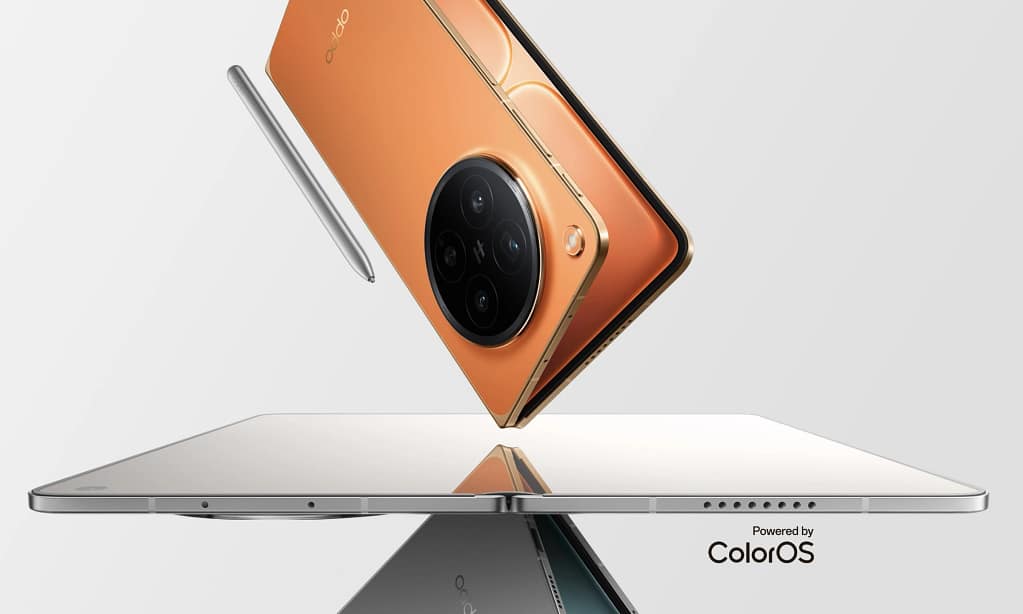
The foldable phone market has carried one inconvenient truth for nearly a decade—every device, no matter how expensive or how refined, folds in half and leaves a crease to prove it. That single flaw has quietly kept millions of potential buyers away from the category. With the Oppo Find N6, launched on March 17, 2026, that excuse is almost gone. Oppo has built what it calls the world’s first “Zero-Feel Crease” foldable, and after weeks of hands-on coverage from reviewers across the globe, the consensus is clear: the Oppo Find N6 is the closest any phone has ever come to making the crease disappear entirely.
I’ve been following the foldable space closely for a while, and honestly, the crease was always the one thing I kept coming back to as a dealbreaker. The Find N6 changed how I think about that.
How Oppo Actually Engineered the Zero-Feel Crease
Most tech coverage jumped straight to the headline and moved on. What most articles missed is the level of manufacturing precision involved in achieving this, and it’s genuinely extraordinary. Every single hinge unit in a Find N6 goes through individual 3D laser scanning at 0.3-micrometer precision.
That scan creates a detailed relief map of the hinge surface, identifying every microscopic irregularity. Oppo then uses a chip-level polymer 3D liquid printing process to deposit tiny droplets of material exactly where the surface is uneven, which are then UV-cured layer by layer, repeating this cycle more than 20 times per unit.
The result? Hinge height variance drops from the industry standard 0.2 mm down to just 0.05 mm—a 75% reduction. To put that into perspective, a single strand of human hair is approximately 0.07 mm wide. The surface beneath the display is now smoother than that. This isn’t a software trick or a marketing reframe. It’s a change in how the physical hardware is manufactured, one unit at a time.
When I first heard about this, I didn’t think much of it, but after digging into the engineering details, I changed my mind completely. This is production-line precision typically reserved for semiconductor fabrication, applied to a consumer smartphone hinge.
The Oppo Find N6 Crease That’s Still There: Why It Barely Matters
Here’s the honest take that most enthusiast coverage glossed over: The Find N6 is not fully creaseless. You can still see a faint line along the middle of the display when you look at an off-axis angle. In normal, straight-on use, most reviewers report not seeing it at all — and more importantly, they report not feeling it. That tactile invisibility is the real breakthrough here.
Oppo pairs the hinge engineering with Auto-Smoothing Flex Glass, a customized flexible glass that is 50% thicker than conventional ultra-thin glass (UTG) used across most foldables. According to TÜV Rheinland testing, combining the second-generation Titanium Flexion Hinge with this new glass reduces long-term crease depth by up to 82% compared to the previous generation. This isn’t just day-one flatness—the display is certified to remain this flat after 600,000 folds, with the hinge assembly itself certified through one million fold cycles and carrying TÜV Rheinland’s formal minimized crease certification.
Personally, I think the distinction between “crease-less” and “zero-feel” is exactly the right way to frame this. Oppo isn’t lying. The crease exists. You just won’t feel it, and in regular use, you won’t see it either.
Oppo Find N6 Specs That Hold Their Own Against Any Flagship
The crease story dominates the conversation around the Find N6, but the rest of the hardware deserves serious attention too. The phone carries a 6.62-inch outer display and an 8.12-inch inner OLED screen, with peak brightness pushed to 3,500 nits on the cover display and 2,500 nits on the inner panel — both notable upgrades over the Find N5. Folded, the device measures just 8.93mm thick and weighs 225g, making it directly comparable to the Samsung Galaxy Z Fold 7 in form factor.
Under the hood sits the Snapdragon 8 Elite Gen 5 — the most powerful chip Qualcomm offers right now — paired with up to 16GB of LPDDR5X RAM and up to 1TB of UFS 4.1 storage. The software runs ColorOS 16 based on Android 16, with OPPO committing to five years of Android OS updates and six years of security patches.
Cameras are handled by a Hasselblad-tuned triple system: a 200MP main sensor, a 50MP 70mm telephoto, and a 50MP ultrawide. For a foldable phone, that camera array is genuinely competitive against dedicated camera flagships, though reviewers note that the telephoto still doesn’t quite match the Pixel 10 Pro Fold’s 5x zoom reach.
After looking into this more closely, I can tell you that the 200MP sensor on a foldable is a genuinely surprising leap — that’s a specification that most bar-style phones haven’t matched yet.
The Battery Life Numbers That Should Embarrass Every Other Foldable
This is the buried statistic that deserves far more attention than it’s received in most coverage. The Oppo Find N6 carries a 6,000mAh silicon-carbon battery. For context, that’s 400 mAh more than the Find N5 and 1,600 mAh more than the Galaxy Z Fold 7. Battery rundown testing on the outer display while playing continuous video lasted just under 30 hours. Using the larger inner screen still delivered 24 hours of runtime. Those figures are remarkable for any smartphone in 2026, let alone a foldable.
Charging is handled by 80W SUPERVOOC wired charging and up to 55W wireless charging — meaning that enormous cell tops up quickly. This combination of capacity and charge speed is genuinely industry-leading for the foldable category, and it’s a spec that most reviews mentioned briefly before moving on. It shouldn’t be treated as a footnote. A foldable that lasts all day and half the next still charges quickly, removing one of the last practical objections to daily driver adoption.
The Real Problem: You Almost Certainly Can’t Buy It
Here is where the excitement hits a wall. Oppo has confirmed the Find N6 will launch primarily across Asia-Pacific markets — China, Malaysia, Japan, Australia, and New Zealand — with no plans to bring it to Europe and no confirmed US availability. That’s not just a regional disappointment; it’s a strategic pattern that has held across multiple Find N generations.
Industry insiders hint that Oppo’s sister brand, OnePlus, which has a significantly broader presence in Western markets, may eventually bring similar hinge and display technology to a potential OnePlus Open follow-up. Sources suggest that some of the Find N6’s engineering may filter through to international markets via OnePlus, but there’s been no official confirmation, and the rumored OnePlus Open 2 has already been delayed once.
Many believe the pressure Apple’s rumored foldable iPhone will put on the category could force both Oppo and Samsung to accelerate their global distribution strategies—but for now, the Find N6 remains a phone most of the world can admire only from a distance.
The Oppo Find N6 is the most complete foldable phone ever made. Its crease is not fully invisible, but it is closer to invisible than any phone before it, backed by independent certification and verified by weeks of hands-on testing from multiple publications.
The engineering Oppo deployed to achieve the Zero-Feel Crease sets a new benchmark that every foldable manufacturer—Samsung, Google, Honor, and eventually Apple—will have to respond to. The question for the next twelve months is not whether this technology will become the new industry standard. It already is. The question is when the rest of the world will finally get to buy a phone built around it.