Farmers have been locked in a manual and chemical battle with weeds since the beginning of organized agriculture. However, on February 2, 2026, the Seattle-based agtech firm Carbon Robotics introduced what may be the most decisive shift in this conflict to date. The company unveiled its Large Plant Model (LPM), a foundational AI model built specifically for the complexities of the field. Unlike generic computer vision, the LPM was trained on a massive dataset of over 150 million labeled plant images, all captured from active farming operations across the globe.
This isn’t just an incremental update. The LPM provides the “intelligence” for the LaserWeeder, allowing it to identify and eliminate weeds—ranging from common broadleaves to the notoriously difficult nutsedge—with sub-millimeter precision. What truly separates this model from its predecessors is the removal of the “retraining lag.” Previously, identifying a new weed variant required a 24-hour cycle of data processing and model updates. With the new Plant Profiles feature, a farmer can simply take two photos on an iPad and designate a plant as a “kill” or “protect” target, and the entire global fleet is updated almost instantly via over-the-air deployment.
Moving Beyond Simple Pattern Recognition
Having tracked Carbon Robotics from its early prototypes, it is clear that the LPM represents a maturing of agricultural AI. It has moved beyond simple pixel-matching. CEO Paul Mikesell has noted that the model now understands plants on a structural and semantic level. It doesn’t just see a green shape; it analyzes leaf venation, growth stages, how the soil might be partially obscuring a leaf, and the relationship between the crop and its neighbors.
Currently, this system is active on more than 100 farms across 15 countries, including major operations in the United States and Australia. By processing data from environments as different as California strawberry fields and Australian broadacre grain fields, Carbon Robotics has effectively built the most comprehensive agricultural dataset in existence. Supported by $185 million USD in funding from investors like Nvidia NVentures and Bond Capital, the company is creating a “data moat” that becomes more difficult for competitors to cross with every acre the robots cover.
The Hardware: Precision at an Industrial Scale
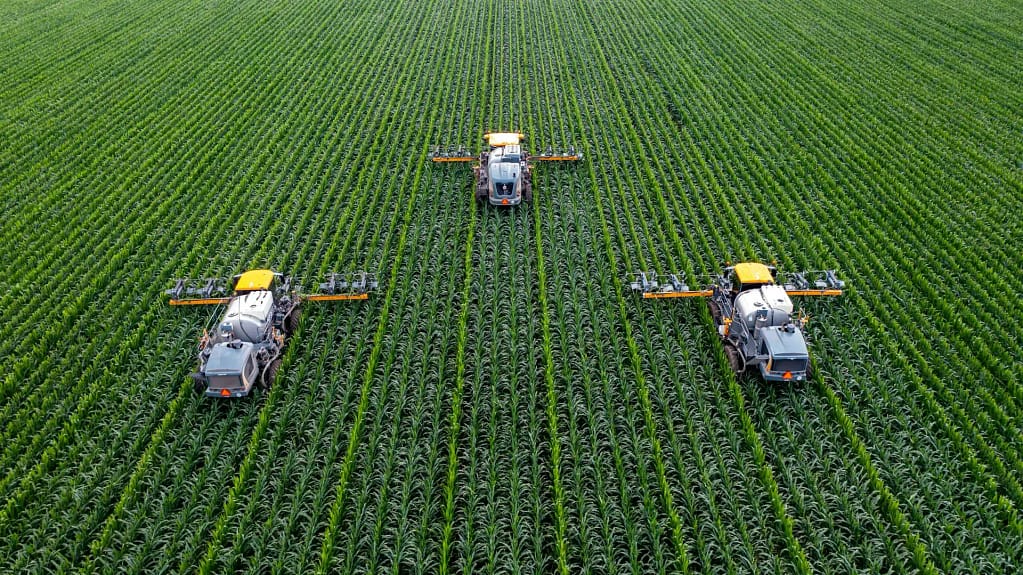
The intelligence of the LPM requires a physical platform capable of high-speed execution. The LaserWeeder G2 1200 is that platform. Built for the rigors of commercial farming, the G2 is equipped with 32 independent industrial $CO_2$ lasers. These are not just sensors; they are high-energy tools capable of vaporizing 5,000 weeds every minute.
By targeting the meristem—the growth point of the weed—the lasers ensure the plant cannot regrow, all while leaving the surrounding crop completely undisturbed. The machine maintains this level of precision while being towed at speeds of 5 to 12 miles per hour. Perhaps most impressively, it is designed for 24/7 operation. Whether it is working through the dust of a midday heatwave or the total darkness of a midnight shift, the combination of high-resolution RGB cameras and multispectral sensors allows the LPM to maintain a 90–99% weed control rate.
The Economic Case for Chemical-Free Weeding
For many growers, the shift to laser weeding isn’t just about being “high-tech”; it is a matter of survival. Weeds cost the global agricultural industry approximately $100 billion USD annually by stealing water, light, and nutrients. Furthermore, the reliance on herbicides like glyphosate has led to a crisis of chemical resistance, forcing farmers to use more toxic combinations just to keep their yields stable.
The financial logic of the LaserWeeder G2 is compelling. While the initial investment is significant—around $200,000 USD—most high-density operations see a full return on investment within one to three years. This is achieved through a dramatic reduction in labor costs (often eliminating the need for large manual weeding crews) and a slash in herbicide expenses. In Washington State, carrot growers have reported saving $20,000 USD in chemical costs in just their first season. Beyond the direct savings, there is a yield bonus: crops that don’t have to compete with weeds or endure “herbicide shock” tend to be healthier, often resulting in a 10–20% increase in total harvest volume.
A Learning Loop That Never Stops
Carbon Robotics has essentially turned every LaserWeeder into a data-collection scout. The “Field-to-Model” pipeline ensures that the AI is constantly evolving. In the past, lab-trained AI models often failed in the field because they couldn’t handle “noise”—dust on a leaf, weird shadows at dusk, or rain-splattered mud. Because the LPM is trained on real-world “noise,” it is exceptionally rugged.
The Ops Center app puts this power directly in the hands of the grower. If a farmer discovers a rare variant of bindweed among their basil, they don’t have to wait for a technician. They tag it, and the system learns. This decentralized, federated learning approach ensures that as one farm gets smarter, the entire network of 175+ robots follows suit.
Sustainability and the Future of the Field
As global regulations on chemicals tighten—particularly in the European Union and parts of the United States—the ability to farm without herbicides is becoming a strategic necessity. Carbon’s approach allows farmers to meet organic certification standards or “zero-residue” mandates with almost no extra effort.
Looking ahead to the rest of 2026, Carbon Robotics is focusing on deeper integration with its Autonomous Tractor Kit (ATK). The goal is a fully independent weeding operation where the machine navigates the field, identifies the threats, and executes the mission without constant human supervision. With technical partnerships with Nvidia pushing the boundaries of “sensor fusion”—combining LiDAR and hyperspectral imaging—the line between “farming” and “high-end robotics” is blurring permanently.